By Babangida Ahmed,
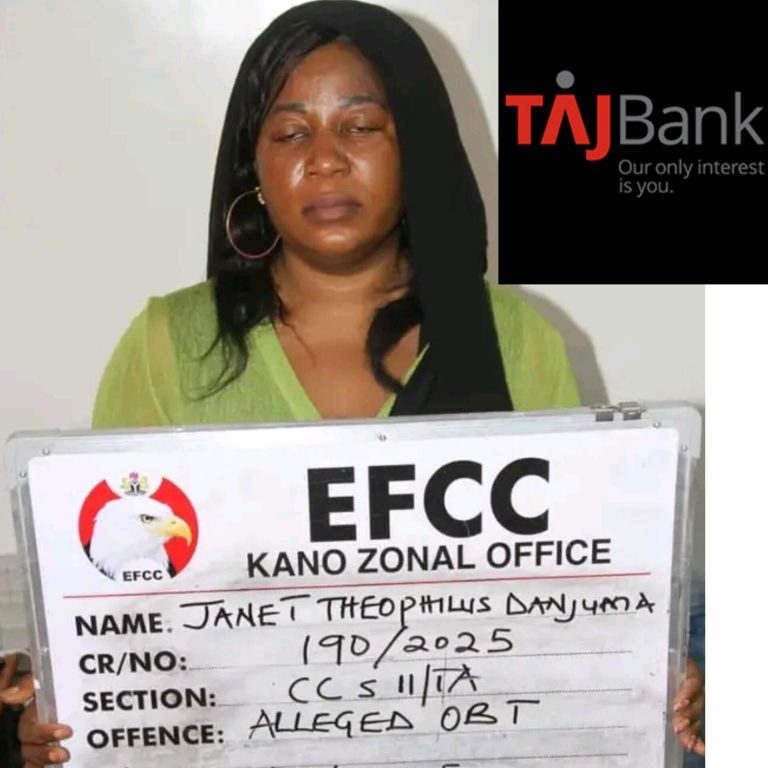
The Economic and Financial Crimes Commission (EFCC) has secured the conviction of a bank employee, Janet Theophilus Danjuma, for defrauding an investor of N22,350,000 through a bogus investment scheme in Kano.
Danjuma, a staff member of Taj Bank Limited, Nai’bawa Branch, was convicted on Monday, February 16, 2026, by Justice S. M. Shuaibu of the Federal High Court, Kano Division. The court sentenced her to five years’ imprisonment without the option of a fine.
She was arraigned on a one-count charge bordering on obtaining money by false pretence. According to the charge, the defendant in October 2024 dishonestly obtained N22,350,000 from Wade Bamaiyi under the guise of investing the funds in Taj Bank’s Current Account Savings Account (CASA) programme.
Part of the charge read: “Janet Theophilus Danjuma, being a staff of Taj Bank Limited, Nai’bawa Branch Kano, sometime in October 2024 in Kano, within the jurisdiction of this Honourable Court, with intent to defraud, did obtain the sum of N22,350,000 from Wade Bamaiyi under the pretext that the money would be invested in CASA Programme of Taj Bank Limited, which pretext you knew to be false.”
The offence is contrary to Section 1(1)(b) and punishable under Section 1(3) of the Advance Fee Fraud and Other Fraud Related Offences Act, 2006.
Danjuma pleaded guilty when the charge was read to her.
Prosecuting counsel, Sadiq Huseini, told the court that the defendant leveraged her position as a bank staff and the credibility of a legitimate banking product to deceive the complainant.
“The defendant used her position as a bank staff and the credibility of an existing financial product to deceive the complainant into parting with N22,350,000,” Huseini said. “Investigation traced the entire sum to her personal account.”
He urged the court to convict and sentence her in line with the law, stressing that the offence eroded public confidence in the nation’s financial system.
In his ruling, Justice Shuaibu convicted Danjuma based on her guilty plea and handed down a five-year prison sentence without an option of fine.
The EFCC said investigations revealed that the purported investment scheme was non-existent and that the funds were diverted for personal use.