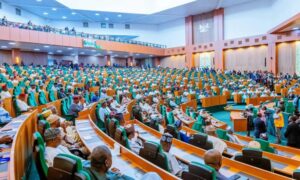
The House of Representatives on Thursday passed the Executive Bill seeking to establish state police services, advancing efforts to decentralise Nigeria’s policing structure and reinforce the country’s internal security framework.
The bill scaled through during plenary after the House stepped down its earlier constitutional amendment proposal on state police in favour of the Executive Bill transmitted by President Bola Tinubu.
The passage follows the Senate’s earlier approval of its own version of the legislation, moving Nigeria a step closer to a dual policing arrangement in which state-controlled police services would operate alongside the Nigeria Police Force.
A total of 311 lawmakers took part in the voting. Speaker of the House, Tajudeen Abbas, disclosed that 276 members voted from the chamber, while 35 others participated virtually.
“A total of 311 members participated in this voting exercise, with 276 voting from the chamber and 35 participating virtually,” Abbas announced.
The bill was passed after lawmakers considered and adopted the report of the House Committee on the Review of the 1999 Constitution, chaired by Deputy Speaker Benjamin Kalu.
The legislation, titled “A Bill for an Act to Alter the Constitution of the Federal Republic of Nigeria, 1999 to Provide for the Establishment of State Police Services and for Related Matters (HB. 2797),” seeks to amend the Constitution to create a legal framework for state police services to operate alongside the federal police.
Its passage marks another milestone in Nigeria’s long-running debate on decentralising policing, as the country continues to grapple with banditry, kidnapping, terrorism and other security challenges.
President Tinubu had transmitted the Executive Bill to the National Assembly last week, explaining that it builds on previous legislative efforts while introducing additional safeguards to ensure an effective, accountable and well-coordinated dual policing system.
“The proposed constitutional amendment is designed to strengthen Nigeria’s security architecture and improve the nation’s capacity to respond to evolving security threats,” the President said.
Following the submission of the Executive Bill, the House rescinded its June 11, 2026 resolution on state police and dissolved the 12-member conference committee constituted on July 9 to harmonise earlier versions of the amendment. Lawmakers subsequently resolved to proceed with the executive-backed proposal, which is expected to provide a more comprehensive legal framework for implementing state police once the constitutional amendment process is completed.
The establishment of state police remains one of Nigeria’s most debated constitutional reforms. Proponents argue that devolving policing powers would enhance intelligence gathering, promote community policing, and enable quicker responses to security challenges at the grassroots level.