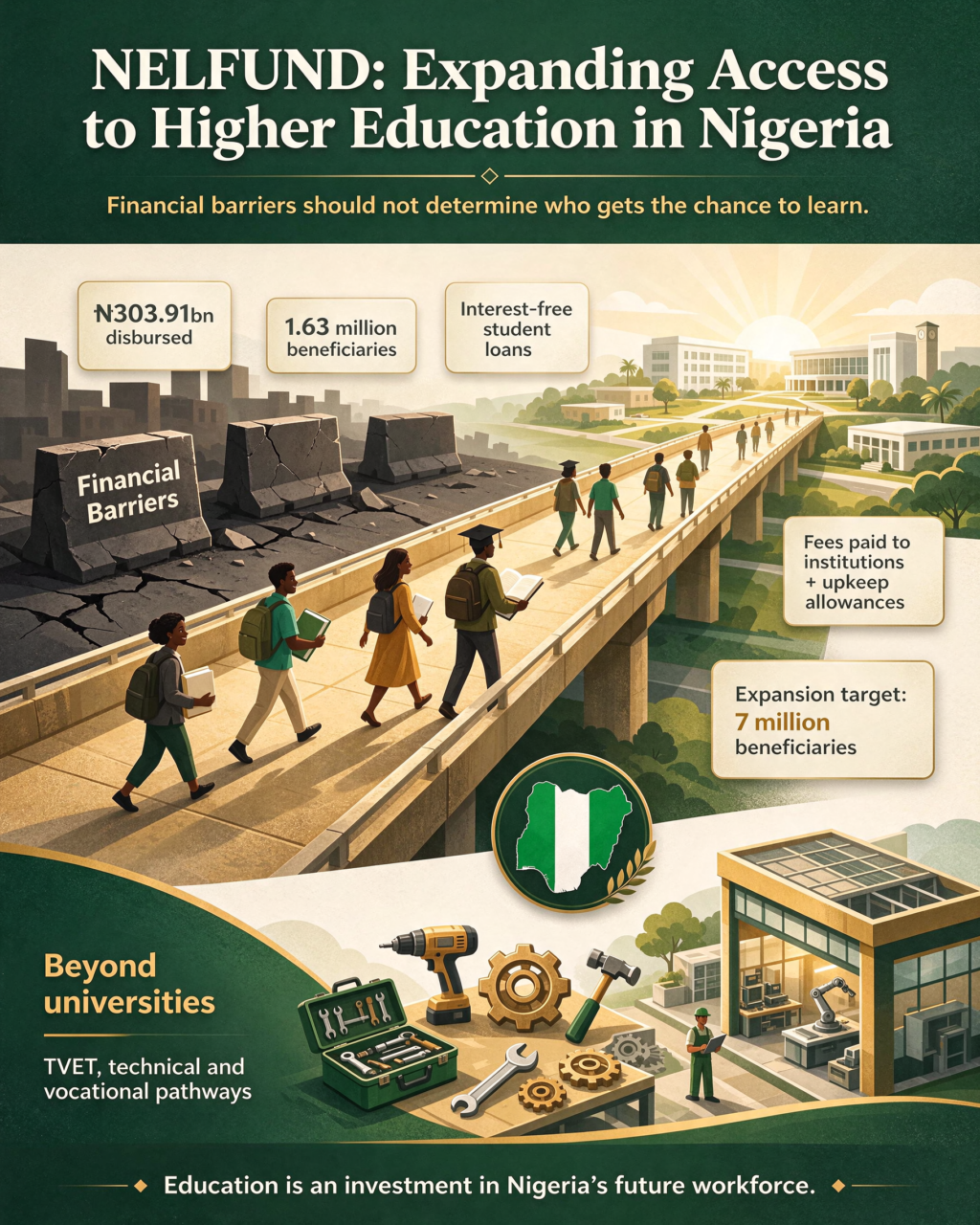
With more than ₦303.91bn disbursed to 1.63 million students, the Nigerian Education Loan Fund is emerging as a major intervention in the country’s education sector, easing financial pressures on families and giving thousands of young people a second chance at their academic ambitions.
For thousands of Nigerian students, the prospect of obtaining a university or polytechnic education has long been threatened by one persistent obstacle: the inability to pay school fees and meet the rising cost of living.
Across the country, financial difficulties have forced students to defer admission, suspend their studies or abandon their academic ambitions altogether. For many families, particularly those struggling with the pressures of a difficult economy, the cost of higher education has become an increasingly difficult burden.
It is against this background that the Nigerian Education Loan Fund (NELFUND) was established by the Federal Government to widen access to tertiary education through interest-free student loans.
Since its introduction, the scheme has begun to change the conversation about educational financing in Nigeria, providing financial support to students who might otherwise have struggled to complete their studies.
By July 2026, NELFUND had disbursed approximately ₦303.91bn to more than 1.63 million beneficiaries across participating tertiary institutions. The funds cover institutional charges, paid directly to the institutions, as well as monthly upkeep allowances for eligible students.
The figures represent a significant intervention in a country where the financial circumstances of parents and guardians have historically determined whether many young people can pursue higher education.
President Bola Ahmed Tinubu signed the Student Loans (Access to Higher Education) Act in June 2023, establishing the legal framework for the initiative. The legislation was subsequently repealed and re-enacted, with the revised Act receiving presidential assent on April 3, 2024.
The amendments removed some of the earlier restrictions, including family income thresholds and guarantor requirements, making the facility more accessible to students from different economic backgrounds.
The official application portal opened on May 24, 2024, under the leadership of NELFUND’s Managing Director and Chief Executive, Akintunde Sawyerr.
The scheme provides interest-free loans to eligible students in public tertiary institutions, covering institutional fees and approved upkeep allowances. Repayment is linked to beneficiaries’ employment and income status and is governed by the provisions of the law.
The underlying principle is that graduates should not be burdened with repayment obligations before they have the means to meet them. Rather, the programme is designed to give students the opportunity to complete their education, acquire relevant skills and secure employment before repayment becomes applicable.
A growing national intervention
Beyond the financial figures, NELFUND’s significance lies in its potential to address one of the most persistent inequalities in Nigeria’s education system: the relationship between household income and access to higher education.
For students from disadvantaged backgrounds, the availability of financial assistance can determine whether an admission offer translates into an actual university education.
The scheme has also provided some relief to parents and guardians who previously had to shoulder the entire cost of their children’s education, often at considerable personal sacrifice.
By paying institutional charges directly to participating institutions and providing upkeep allowances to eligible beneficiaries, NELFUND has sought to address two major aspects of student financing.
The intervention has enabled many students to concentrate more fully on their academic work rather than spend valuable time seeking menial employment to meet tuition and basic living expenses.
Its growing reach has also attracted attention from education administrators, policy experts and other stakeholders, particularly regarding the long-term sustainability of the programme, its funding arrangements, repayment mechanisms and administrative efficiency.
These questions are important given the increasing demand for student loans and the government’s ambition to extend the programme to millions more Nigerians.
On June 15, 2026, the National Assembly, working with NELFUND management, unveiled a nationwide sensitisation and expansion strategy targeting seven million direct beneficiaries.
The announcement was made during a one-day national sensitisation programme in Abuja, organised by the Senate Committee on Tertiary Education and TETFund in collaboration with NELFUND.
The initiative was designed to increase public awareness, improve stakeholder engagement and simplify access to educational financing for eligible students across the country.
The campaign also seeks to address the information gap that has prevented some qualified students from taking advantage of the scheme.
Although the number of beneficiaries has increased substantially, many students remain unaware of the application process, eligibility conditions and procedures for accessing the facility.
The expansion strategy is therefore intended to ensure that information reaches students beyond the major university campuses, particularly those from disadvantaged communities.
Beyond universities: The case for vocational education
However, the long-term ambitions of NELFUND should not be restricted to conventional university and polytechnic education.
Nigeria’s development challenges require a broader approach to human capital investment, one that recognises the importance of technical education, vocational training, professional development and skills acquisition.
Expanding the programme to embrace Technical and Vocational Education and Training (TVET) institutions could significantly increase its reach and provide opportunities for young Nigerians whose career aspirations lie outside the traditional academic system.
With unemployment and skills shortages continuing to pose challenges to economic development, technical and vocational education offers an important pathway towards self-employment, entrepreneurship and industrial productivity.
A broader student financing framework would therefore help ensure that young Nigerians are not excluded from opportunities for personal and professional advancement simply because they have chosen a technical or vocational career.
Legislative support, institutional cooperation and sustained government commitment will be necessary to achieve this objective.
What beneficiaries say
The experiences of beneficiaries provide an important perspective on the programme’s impact.
A student of Modibbo Adama University (MAU), Yola, Abbas Aminu, said the loan had significantly reduced the financial pressure associated with his education.
He explained that the assistance, including the monthly upkeep allowance, had enabled him to concentrate more effectively on his studies without constantly worrying about school-related expenses.
While commending the government for introducing the initiative, Aminu called for improvements in disbursement timelines to ensure that beneficiaries receive their entitlements promptly.
He also urged NELFUND and participating institutions to strengthen communication with students, arguing that timely information would improve transparency and reduce unnecessary administrative difficulties.
The Rector of the Federal Polytechnic, Mubi, Dr Abdulrahman Ishiaka, similarly commended the initiative, describing it as an important intervention in expanding access to higher education.
He noted that the programme had helped institutions support eligible students and ease some of the financial difficulties confronting families.
According to him, institutions undertake the necessary verification and documentation processes after receiving funds to ensure that successful applicants benefit from the scheme.
Abdulwahab Shehu, NELFUND desk officer at Modibbo Adama University, also described the programme as a major step towards widening access to tertiary education.
He advised students to familiarise themselves with the eligibility requirements, application procedures, necessary documentation and repayment conditions before applying.
Individual stories behind the statistics
Perhaps the most compelling evidence of NELFUND’s potential lies in the personal experiences of students whose educational ambitions were threatened by poverty.
The story of Migwe Nicholas, a University of Lagos student, illustrates the difference financial assistance can make.
Describing himself as the only member of his family to gain admission into a university, Nicholas said his family’s difficult circumstances had almost prevented him from pursuing higher education.
“I am the only person in my family that made it to University,” he said.
Coming from a poor and broken family, he faced considerable financial difficulties that threatened to derail his academic journey.
NELFUND’s intervention has provided support for his tuition fees, enabling him to remain in school despite his challenging circumstances.
His experience reflects the situation of many young Nigerians whose academic potential is not necessarily limited by their intellectual abilities but by the economic circumstances into which they are born.
The achievements of two graduates of Ladoke Akintola University of Technology (LAUTECH) provide another perspective on the relationship between financial support and academic performance.
Oladepo Olugbenga, who graduated during the 2024/2025 academic session with a cumulative grade point average of 4.89 out of 5.00 in Electronic and Electrical Engineering, emerged as the institution’s best graduating student.
His journey was marked by significant personal challenges. Growing up in a rural community in Osun State, where his family reportedly lived without electricity for several years, he had to overcome considerable difficulties to pursue his education.
In expressing appreciation for the support he received, Olugbenga reportedly said: “I am honoured to let you know that I am the best graduating student of LAUTECH; your loans made this possible.”
He explained that he had submitted his application using his mobile phone at a time when financial difficulties were threatening his academic concentration.
The Fund subsequently recognised his achievement at its Abuja headquarters.
Another beneficiary, Augustine Oreoluwa, also graduated with a first-class degree in Electronic and Electrical Engineering, recording a CGPA of 4.61 out of 5.00 and emerging as the department’s second-best graduating student.
He credited the student loan scheme with helping him concentrate on his studies rather than become overwhelmed by financial difficulties.
These accounts demonstrate two important dimensions of the scheme: its capacity to keep financially disadvantaged students in school and its potential to support academic achievement.
For Nicholas, the intervention provided an opportunity to continue an education that poverty had threatened to interrupt. For the LAUTECH graduates, it helped create conditions in which academic excellence could be pursued despite economic limitations.
The broader implication is that financial support for education should not be viewed merely as an expenditure but as an investment in the country’s future workforce, innovation and productive capacity.
Education and the wider development agenda
The impact of educational interventions is also evident in programmes designed to address inequalities affecting vulnerable groups.
In Adamawa State, the State Project Coordinator of the Adolescent Girls Initiative for Learning and Empowerment, Sidiku Liman, highlighted the importance of targeted interventions in improving access to education for adolescent girls.
He disclosed that more than 2,000 schools across the state’s 21 local government areas had been listed for various interventions, including construction and renovation.
The programme had also recruited more than 3,000 teachers, comprising male and female educators, to strengthen teaching capacity and encourage more girls to remain in school.
Such initiatives complement the objectives of NELFUND by addressing different dimensions of educational inequality.
While student financing helps remove financial barriers to tertiary education, interventions targeting school infrastructure, teaching capacity and girls’ enrolment seek to strengthen the foundations of access much earlier in the educational system.
Together, they demonstrate the importance of a coordinated approach to human capital development.
The Minister of Education, Dr Tunji Alausa, has acknowledged that financial hardship remains one of the major reasons students suspend or discontinue their education.
Before the introduction of the scheme, requests for leave of absence were not uncommon as students struggled to reconcile their academic aspirations with the economic difficulties confronting their families.
The student loan initiative, he has noted, is helping to address the problem by improving retention and allowing more students to remain in their institutions.
However, like other major public programmes, NELFUND has encountered operational challenges, including disbursement timelines and institutional verification procedures.
The growing number of beneficiaries has also brought renewed attention to the need for effective financial management, accountability and sustainable funding.
These are legitimate concerns that will require continuous attention if the scheme is to fulfil its objectives.
Sawyerr’s leadership and the task ahead
At the centre of the programme’s implementation is its Managing Director and Chief Executive, Akintunde Sawyerr, whose leadership has been central to the Fund’s institutional expansion and nationwide engagement.
Under his administration, NELFUND has continued to onboard tertiary institutions, simplify application procedures, improve transparency in disbursement and strengthen engagement with vice-chancellors, rectors and other institutional administrators.
The direct payment of institutional charges to participating institutions is also intended to strengthen accountability and ensure that funds reach their designated destinations.
Sawyerr has called on Ministries, Departments and Agencies (MDAs) to take a more active role in publicising the student loan scheme, arguing that government institutions have an important responsibility to ensure that eligible Nigerians are aware of the opportunities available to them.
The call underscores an important consideration: the success of a public intervention depends not only on the availability of funds but also on whether those who need them know how to access them.
Sustained public sensitisation, transparent administration, timely disbursement and effective communication between NELFUND, educational institutions and beneficiaries will therefore remain critical.
The programme must also maintain a balance between expanding access and protecting its long-term financial viability.
A legacy that must be sustained
The Tinubu administration has pursued a series of economic reforms intended to address longstanding structural weaknesses and establish a stronger foundation for sustainable growth.
The reforms have required considerable adjustment from households and businesses, making it increasingly important that their eventual benefits translate into improved living conditions, employment opportunities and greater economic security for ordinary Nigerians.
The administration’s Renewed Hope Agenda places human capital development, infrastructure, job creation, food security and social protection among its priorities.
NELFUND represents an important component of that broader development strategy.
A country cannot achieve sustainable economic progress without investing in the knowledge, skills, creativity and productive capacity of its young population.
Education remains one of the most effective instruments of social mobility, providing individuals with opportunities to improve their circumstances while contributing to national development.
The Northern Youths Professional Progressive Association (NYPPA) has commended President Tinubu, the Federal Government, the National Assembly, NELFUND management and participating tertiary institutions for their contributions to the initiative.
In a statement signed by its National Coordinator, Comrade Shehu Babangida Funtua, and Secretary, Comrade Abubakar Dan Lamido, the association described the student loan scheme as a significant intervention capable of changing the educational prospects of millions of Nigerian youths.
It urged the government to sustain and expand the programme, improve public awareness, address administrative challenges and ensure that beneficiaries receive their entitlements without unnecessary delays.
The association also called for the inclusion of vocational, technical and skills-acquisition institutions in the scheme, arguing that access to education and professional development should extend beyond conventional university qualifications.
It encouraged beneficiaries to use the facility responsibly, remain committed to academic excellence and recognise the opportunity as an investment in their future and a responsibility to contribute to national development.
Ultimately, NELFUND’s success will be measured not only by the amount disbursed or the number of students enrolled but also by the number who complete their education, acquire relevant skills and secure opportunities to become economically productive.
Its ability to reach students from disadvantaged backgrounds, maintain transparent operations and remain financially sustainable will determine whether the initiative becomes a lasting feature of Nigeria’s educational system.
For the young Nigerians whose academic ambitions have been kept alive by the intervention, the significance is already evident.
A student who might have abandoned university can now remain in school. A graduate who might have struggled to finance an education can emerge with a first-class degree. A family that once viewed tertiary education as financially unattainable can begin to see it as a realistic possibility.
In a country where poverty continues to deny many young people opportunities, the principle behind NELFUND is straightforward: financial circumstances should not determine who gets the chance to learn, develop and contribute to society.
The challenge now is to ensure that the promise of the scheme is sustained, its shortcomings addressed and its reach extended to millions more Nigerians.
If effectively managed, NELFUND could become one of the most consequential investments in the country’s human capital, demonstrating that widening access to education is not simply a social responsibility but an economic necessity.
Signed:
Comrade Shehu Babangida Funtua National Coordinator Northern Youths Professional Progressive Association (NYPPA)
Comrade Abubakar Dan Lamido Secretary Northern Youths Professional Progressive Association (NYPPA)